







Fish Eye CCTV Camera
Industrial, Commercial & Corporate Security
1. Introduction
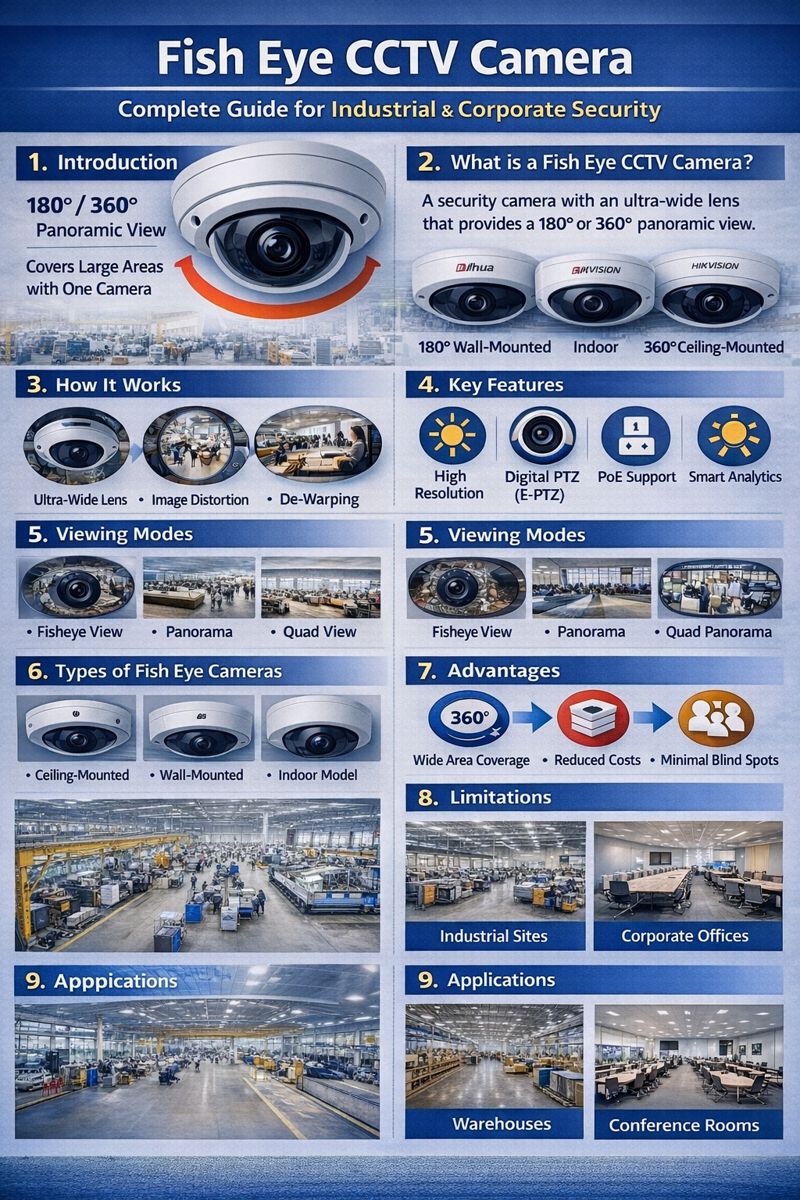
In today’s security-driven environment, surveillance systems are essential for protecting people, property, and assets. The Fish Eye CCTV Camera is an advanced surveillance solution designed especially for large open areas. It uses an ultra-wide-angle lens to capture 180° or 360° panoramic views with a single camera, reducing blind spots and minimizing the need for multiple cameras. Fish eye cameras are widely used in industries, offices, malls, airports, hospitals, warehouses, control rooms, and command centers, where complete situational awareness is required.
2. What is a Fish Eye CCTV Camera?
A Fish Eye CCTV Camera is a specialized camera fitted with a fisheye lens, inspired by the wide vision of a fish. It produces a circular, wide-angle image covering a large area. Based on installation:
• 180° view – wall-mounted
• 360° view – ceiling-mounted
Although the raw image appears distorted, de-warping software in the camera or NVR converts it into normal, easy-to-view formats.
3. How It Works
The fisheye lens captures light from all directions at once, creating a curved image. This image is digitally processed using de-warping technology to generate:
• Panorama view
• Quad view
• E-PTZ (electronic pan, tilt, zoom)
The corrected video is then displayed live and recorded for playback.
4. Key Features
• 360° panoramic coverage
• High resolution (4MP, 5MP, 8MP/4K)
• De-warping technology
• Digital PTZ (E-PTZ)
• PoE support for easy installation
• Smart analytics such as motion detection, intrusion detection, people counting, heat mapping, and loitering detection
5. Types
• Ceiling-mounted: 360° view for halls and warehouses
• Wall-mounted: 180° view for corridors and entrances
• Indoor models: offices and control rooms
• Outdoor models: IP66/IP67 for parking and open areas
6. Viewing Modes
Original fisheye, panorama, quad view, dual panorama, and E-PTZ modes improve monitoring efficiency.
7. Advantages
Fish eye cameras provide wide coverage, reduced installation cost, minimal blind spots, better situational awareness, and a compact, aesthetic design.
8. Limitations
They require de-warping software, offer limited detail at long distances, and need higher processing power and storage.
9. Applications
Used in industrial floors, corporate offices, retail malls, airports, hospitals, and educational institutions for effective security monitoring.
Disclaimer – This post has only been shared for an educational and knowledge-sharing purpose related to Technologies. Information was obtained from the source above source. All rights and credits are reserved for the respective owner(s).
Keep learning and keep growing
Source: LinkedIn
Credits: Mr. Manoj Sahoo