







SATA vs SAS HDDs: Which is Better for Surveillance?

SATA vs SAS HDDs: Which is Better for Surveillance?
In the surveillance industry, where data is constantly being written and accessed across hundreds (or thousands) of video streams, the choice of storage hardware plays a critical role in system performance, reliability, and long-term cost.
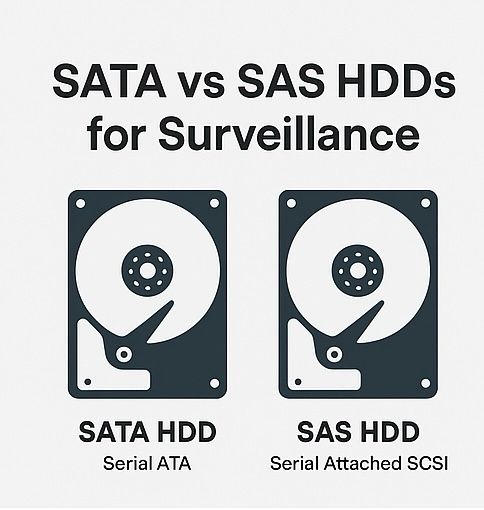
When it comes to HDDs, two key options are available: SATA (Serial ATA) and SAS (Serial Attached SCSI). Here’s a surveillance-focused breakdown of how they compare:
1. Workload Type
• SATA:
• Designed for sequential data writing, which makes it suitable for continuous video recording.
• Ideal for small to mid-sized surveillance setups with fewer channels or where cost per TB is a priority.
• SAS:
• Supports concurrent reads/writes, ideal for surveillance systems with high video analytics workloads, multiple users accessing footage simultaneously, or mission-critical setups.
⚙️ 2. Performance
• SATA HDDs:
• Speeds up to 6 Gbps.
• Adequate for 24/7 video recording.
• SAS HDDs:
• Up to 12 Gbps, lower latency.
• Suitable for systems with high-definition cameras (4K+), AI/analytics integration, or centralized storage with high demand.
3. Reliability & Durability
• SATA:
• MTBF ~1 million hours.
• Lower endurance; typically rated for 180 TB/year workload.
• SAS:
• MTBF up to 2.5 million hours.
• Higher endurance, often rated for 550 TB/year or more.
• Better suited for mission-critical and multi-site surveillance environments.
4. Storage Architecture
• SATA:
• Single-port access, which limits redundancy.
• Good for standalone or NVR-based systems.
• SAS:
• Dual-port support allows redundancy and multipath access—crucial for failover in enterprise-grade surveillance networks or VMS environments.
5. Cost Consideration
• SATA:
• Lower cost per GB.
• Best fit for budgetry project
• SAS:
• Higher cost but justified by performance, scalability, and reliability.
• Optimal for high-security infrastructures.
✅ Recommendation
• For basic CCTV or SMB surveillance systems, SATA HDDs (especially surveillance-optimized models like WD Purple or Seagate SkyHawk) are typically sufficient.
• For enterprise-grade or mission-critical deployments with high scalability, heavy analytics, or high camera density, SAS drives are the better choice.
Final Thought:
Choosing the right drive isn’t just about storage—it’s about ensuring your surveillance system runs reliably when you need it most. Performance, durability, and scalability matter more as surveillance becomes smarter and more data-intensive.
Disclaimer – This post has only been shared for an educational and knowledge-sharing purpose related to Technologies. Information was obtained from the source above source. All rights and credits are reserved for the respective owner(s).
Keep learning and keep growing
Source: LinkedIn
Credits: Mr. Muhammad Haseem
