







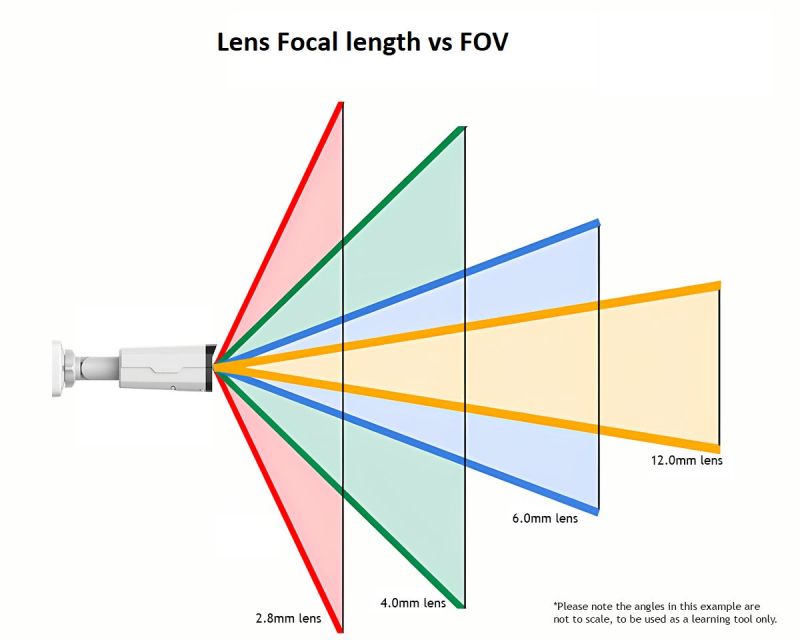
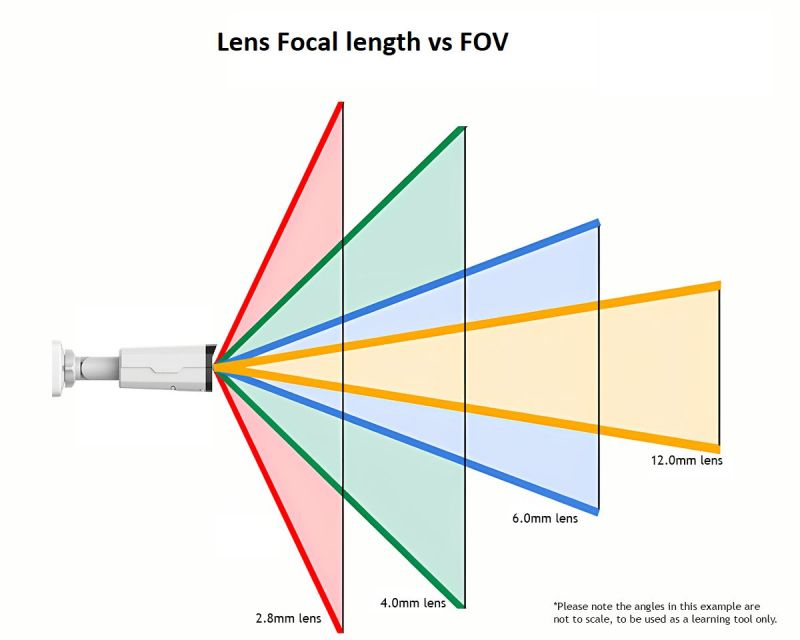
Lens Focal length vs FOV
CCTV Design: More Millimeters ≠ More Coverage
A common mistake in security specs is assuming a “bigger number” for a lens means you see more. In reality, it’s the exact opposite.
If you are choosing a CCTV camera, the focal length (measured in mm) determines your field of view (FOV). As the focal length increases, your view narrows, but your “reach” gets better.
Here is how to choose the right tool for the job:
📐 2.8mm Lens: The Wide Angle
The View: Ultra-wide (roughly 90°–110°).
Best for: Small offices, lobbies, and residential front doors.
The Goal: General surveillance and “big picture” situational awareness.
🏠 4.0mm Lens: The Standard
The View: Medium (roughly 70°–80°).
Best for: Driveways, larger rooms, and parking lots.
The Goal: A balance between seeing a wide area and getting enough detail on faces.
🛣️ 6.0mm to 12.0mm+: The Telephoto
The View: Narrow and Focused.
Best for: Cash registers, narrow hallways, or identifying license plates at a distance.
The Goal: Detail over distance. You lose the periphery to gain “identify” level resolution on a specific target.
💡 Pro-Tip: Don’t just look at the FOV on paper. Consider the DORI standard (Detection, Observation, Recognition, and Identification) to ensure your focal length provides enough pixels on target to actually be useful in an investigation.
Check out the diagram below to see how the “cone” of vision changes as you move from 2.8mm to 12mm!
Disclaimer – This post has only been shared for an educational and knowledge-sharing purpose related to Technologies. Information was obtained from the source above source. All rights and credits are reserved for the respective owner(s).
Keep learning and keep growing
Source: LinkedIn
Credits: Mr. Mohammed Aijaz
