








Fence Security Requirements
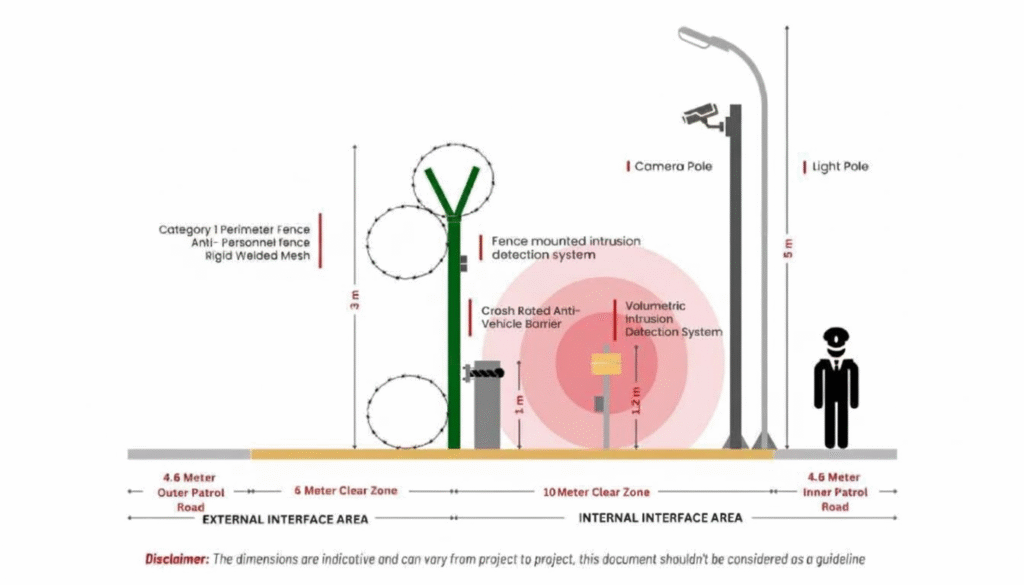
1️⃣ External Interface Area:
This is the area outside the first line of defense, designed for patrol, visibility, and deterrence.
Components:
• 4.6 m Outer Patrol Road – allows vehicle and security patrol movement along the outer boundary.
• 6 m Clear Zone – a completely open area between the road and fence, ensuring unobstructed visibility for guards and surveillance cameras.
Purpose:
To provide surveillance visibility and response access before any intrusion reaches the fence line.
2️⃣ Perimeter Fence Line (Main Barrier):
Located at the boundary between external and internal zones.
Fence Type:
• Category 1 Anti-Personnel Fence (Rigid Welded Mesh)
• Height: 3 meters
• Designed to resist cutting, climbing, and forced entry attempts.
• May include barbed or razor wire on top for additional deterrence.
Additional Integration:
• Fence-Mounted Intrusion Detection System installed directly on the fence to detect vibration, cutting, or climbing attempts in real time.
Purpose:
To delay intruders and trigger an early alarm, providing critical response time to security teams.
3️⃣ Hostile Vehicle Mitigation (HVM) System:
Installed parallel to or just inside the fence.
System Type:
• Crash-Rated Anti-Vehicle Barrier compliant with ASTM F-2656 M50 P1.
• Designed to stop vehicles up to 6.8 tons at 50 mph within a 1m penetration distance.
Purpose:
To prevent forced vehicle entry and protect both the fence line and patrol routes.
⸻
4️⃣ Detection Zone – Internal Interface Area:
Inside the fence, this area includes detection systems and patrol accessibility.
Components:
• 10 m Clear Zone: Maintained inside the fence to keep the area free of obstacles, ensuring full visibility and detection coverage.
• Volumetric Intrusion Detection System (Microwave Sensor):
• Mounted at ~1.2 m height.
• Creates an invisible detection field that triggers an alarm when motion or presence is detected.
Purpose:
To detect intrusions within the protected volume before reaching critical assets.
5️⃣ Surveillance & Lighting Infrastructure:
Located on the internal side for monitoring and illumination.
a. Camera Pole (Height: 5 m):
• Supports CCTV or PTZ cameras.
• Positioned to provide full visual coverage of the fence and patrol roads.
• Often uses A1 Tilt Camera Poles for easy maintenance.
b. Light Pole (Height: 5 m):
• Ensures 24/7 illumination of the patrol roads and fence line.
• Prevents dark zones that could aid intruders.
Purpose:
To maintain continuous visual monitoring and deter nighttime intrusion attempts.
6️⃣ Internal Patrol Road:
• 4.6 m Inner Patrol Road runs along the inner side of the perimeter.
• Provides quick access for security vehicles and response teams after an alarm or detection event.
Disclaimer – This post has only been shared for an educational and knowledge-sharing purpose related to Technologies. Information was obtained from the source above source. All rights and credits are reserved for the respective owner(s).
Source: LinkedIn
Credits: Mr. Zakawat Bashir